Case Study: New York Life Group Benefit Solutions Transformed Medical Data into Insights with Medhub


Agentic AI Unpacked: Strategy and Challenges in Bodily Injury Claims

EvolutionIQ's Tech Leader on Agentic AI
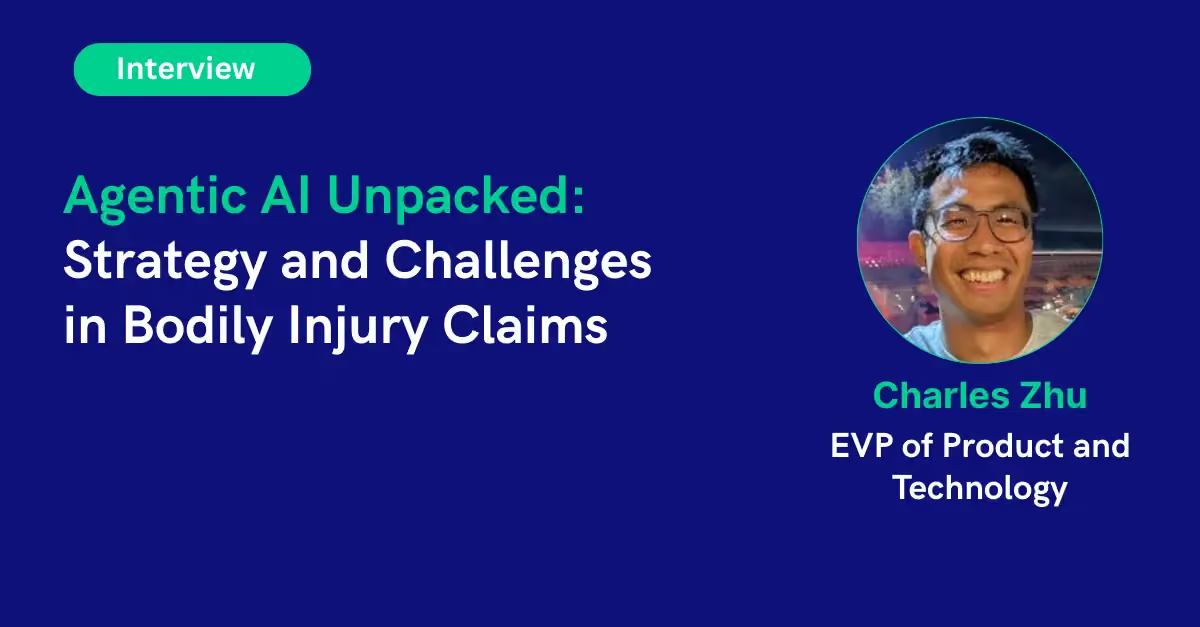
From your perspective as a VP of Product, how do you define Agentic AI?
Agentic AI is a technology where an agent is given a general goal and granted autonomy to execute actions within a system to accomplish that goal. Unlike older rule-based systems that relied on complex if-then statements to capture all possible scenarios, Agentic AI can independently determine the best paths to achieve a goal, such as requesting specific medical records, flagging a case for litigation review, or recommending a reserve adjustment for a bodily injury claim, without needing a human to estimate all possible outcomes upfront.
How does Agentic differ from Predictive AI?
The main difference I see is in the output. Predictive AI doesn't prescribe any actions or plans; it simply classifies or predicts an outcome. For a claim, it might predict how long it will stay open or if it’s likely to become complex. That’s as far as Predictive AI goes.
Agentic AI, conversely, comes into play to execute actions and plans to derisk and mitigate the complexities identified by the prediction. In this way, I find Agentic AI complements and works very well with Predictive AI. Generative AI focus is on summarizing information or generating text responses rather than executing goal-directed actions.
What are the biggest technical challenges you’ve encountered in building agentic AI systems at scale?
One of the greatest technical challenges is managing the non-deterministic nature of Agentic AI, which means it may not yield the same output every time, unlike traditional rules-based systems. To address this, active research is focused on constraining the system by combining the agentic piece with rule systems, guardrails, and Predictive AI to ensure consistent and predictable actions
Another significant technical hurdle is context orchestration, which is ensuring the agent has access to all the necessary information, including details known only to the human examiner, to make the correct decisions
How should you qualify Agentic AI when buying SaaS.
When considering Agentic AI, I'd advise against buying services or software solely based on the technology itself. My emphasis is that the focus should be on the business problem or use case it solves. Whether agents are used or not is irrelevant; the critical factor, in my opinion, is qualifying the use case, which aligns with Evolution IQ's focus.
What are some of the misconceptions of Agentic AI?
Opinions on Agentic AI cover a full spectrum, ranging from an almost "cult-like belief" that it will eliminate all jobs and lead to advanced superintelligence, which to me is viewed as a misunderstanding, to underestimating the current capabilities of the tools.
I believe the truth lies in the middle, and I advise practitioners to focus on what is theoretically possible with the technology and, more importantly, the specific use case they wish to solve.
What is your most useful prompt?
My most useful prompt is a daily recurring request to :"Scan my Drive, summarize key strategic decisions made over the last week, and provide me with executive coaching tips for being a better manager and peer."
I use this summary to start every morning, receiving a list of tasks and personal tips to increase my effectiveness and hopefully keep my team motivated and content.
EvolutionIQ: Claims guidance platform that bodily injury and illness claims organizations use.
EvolutionIQ pioneered Claims Guidance technology in 2019. Carriers using EvolutionIQ for 12+ months have seen loss ratio reductions of up to 3.3 percentage points and an average program ROI of 8–10x. The platform has been adopted by 70% of the top 15 U.S. disability carriers.
Related posts



AI powered Claims Guidance.