Case Study: New York Life Group Benefit Solutions Transformed Medical Data into Insights with Medhub


What did our summer intern - Katy Fallon, value the most from her experience?

Key learning from a summer internship
%20(1).avif)
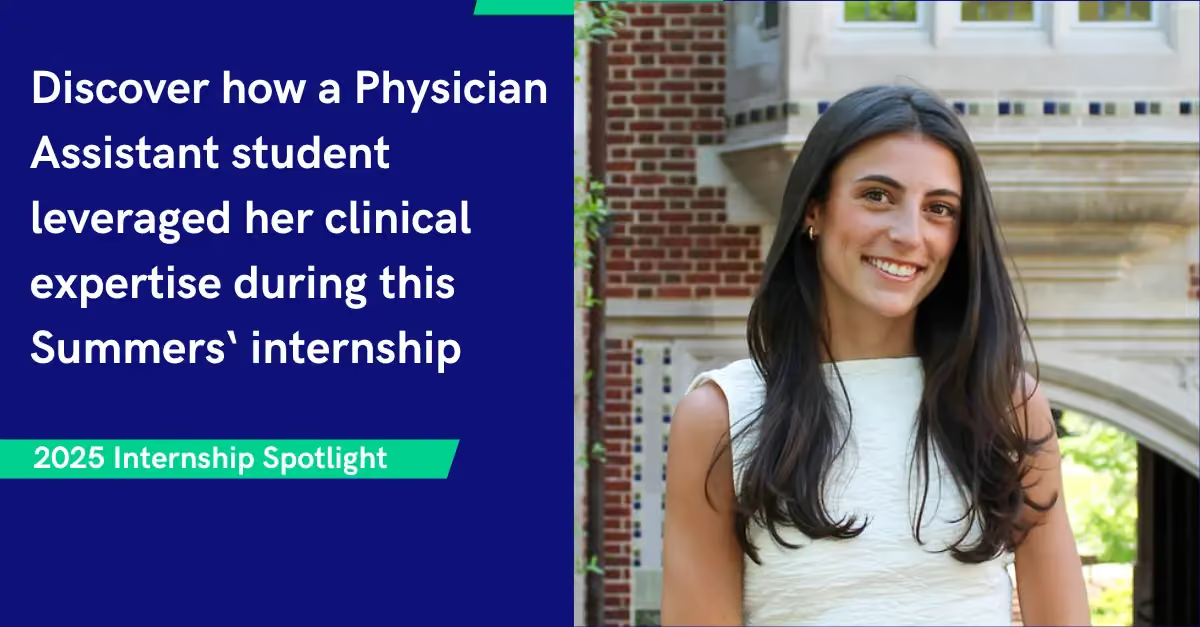
Katy Fallon
Second-year Physician Assistant student
2025 Summer Intern
3 Key Learnings:
- The critical role of incorporating direct user feedback to build truly effective products that solve real-world problems.
- Adaptability as priorities and timelines are constantly shifting.
- The need to translate complex medical information for a non-medical audience to bridge the gap between clinical knowledge and technical development.
My name is Katy Fallon, and as a second-year Physician Assistant student, my education has been deeply rooted in the clinical world of healthcare. When I learned about EvolutionIQ, a company leveraging AI to streamline disability claim examinations, I was immediately drawn to the unique opportunity. The chance to apply my medical knowledge and background in a non-traditional setting, particularly one at the intersection of technology and patient care, felt like a perfect way to broaden my understanding of the healthcare landscape beyond the hospital. I joined the team excited to see how my expertise could contribute to a solution that improves the efficiency and accuracy of a process that directly impacts people's lives.
During my time at EvolutionIQ, I worked closely with the product team and was primarily involved in the development of Medhub, a product designed to help disability claim examiners. This AI-powered tool summarizes complex medical and legal documents, assisting disability claims examiners in understanding these documents and identifying the important information. As someone with a background in healthcare, I worked with the product team and our clinical technology director on quality assurance from a clinical standpoint. We focused on analyzing the AI's output, pinpointing flaws where its logic clashed with medical best practices. The main task was to bridge the gap between clinical knowledge and the engineering team's technical needs, which I accomplished by providing clear explanations and examples to guide them in improving the product. Furthermore, I had the invaluable opportunity to speak with clients, primarily the disability claim examiners that utilized the product. Hearing their direct feedback was eye-opening, and I was able to take their insights back to the team, directly influencing the product’s improvements and making it more effective for its users.
The internship taught me several key lessons. I learned to adapt quickly to the dynamic, iterative nature of a tech company, where timelines are tight and priorities can shift, which taught me to be agile and comfortable with a constant cycle of feedback and improvement. My time here also highlighted the critical skill of communicating complex medical information to a non-medical audience, bridging the gap between clinical knowledge and technical development. Working alongside many different teams highlighted the importance of interdisciplinary collaboration, showing me firsthand how diverse perspectives are crucial for building a truly effective product. This experience also reinforced my belief that the most impactful innovations are those built with deep user understanding, as the client feedback sessions showed how crucial it is to listen to the user and incorporate their lived experience into the design process.
Looking back on my experience, what stands out most is the realization that my medical training is far more versatile than I had ever imagined. This internship wasn't a detour from my clinical studies but rather an expansion of them. I've gained a new perspective on how technology can be a powerful force multiplier for healthcare professionals, freeing up their time to focus on the human element of their work. I'm taking away not just new skills in research and communication, but a profound sense of how my knowledge base can be applied to solve problems on a larger scale. This experience has solidified my interest in health tech and has inspired me to look for future opportunities where I can continue to combine my passion for medicine with the transformative potential of technology, whether that's in a clinical setting or a more innovative, hybrid role.
Related posts


AI powered Claims Guidance.