Case Study: New York Life Group Benefit Solutions Transformed Medical Data into Insights with Medhub


Rethinking the Tradeoff Between Efficiency, Outcomes, and Claimant Experience

Improving the claimant experience, protecting indemnity, and running an efficient operation have always been in tension with one another. Agentic claim handling presents an opportunity to change that.
Speak with any claims leader and they’ll tell you about the importance of improving claimant experience, indemnity outcomes, and operational efficiency. They’ll also quickly acknowledge the invisible tug-of-war that takes place between those three measures, making it seemingly impossible to pull all three in the same direction.
If you’ve led claims teams, you’ve likely felt this tension first-hand in your own past initiatives. For example, you may have chosen to focus on efficiency. Your team was diligent about following SOPs and making decisions quickly. But with that push, some decisions may have happened before the full claims picture was clear. At the same time, claimants experienced something quite different, feeling every handoff between teams and point of friction along the way.
"Claims leadership is the art of navigating service, financial discipline and speed. It’s a constant push and pull that teams work tirelessly to achieve every day. Today, we’re seeing a massive opportunity to ease that tension for leaders and their teams on the front lines."
Mike Saltzman, Co-Founder at EvolutionIQ
The Constraint That’s Forced Claims Leaders to Choose
Claims teams invest heavily in training, procedures, and tools in attempts to optimize one or more of these measures. Yet, the underlying challenge is structural rather than individual.
Examiners are asked to handle a high volume of daily decisions, including many that are routine. Meanwhile, critical information is often incomplete, outdated, or scattered across systems. These pressures force leaders to compromise on where to spend finite human judgment.
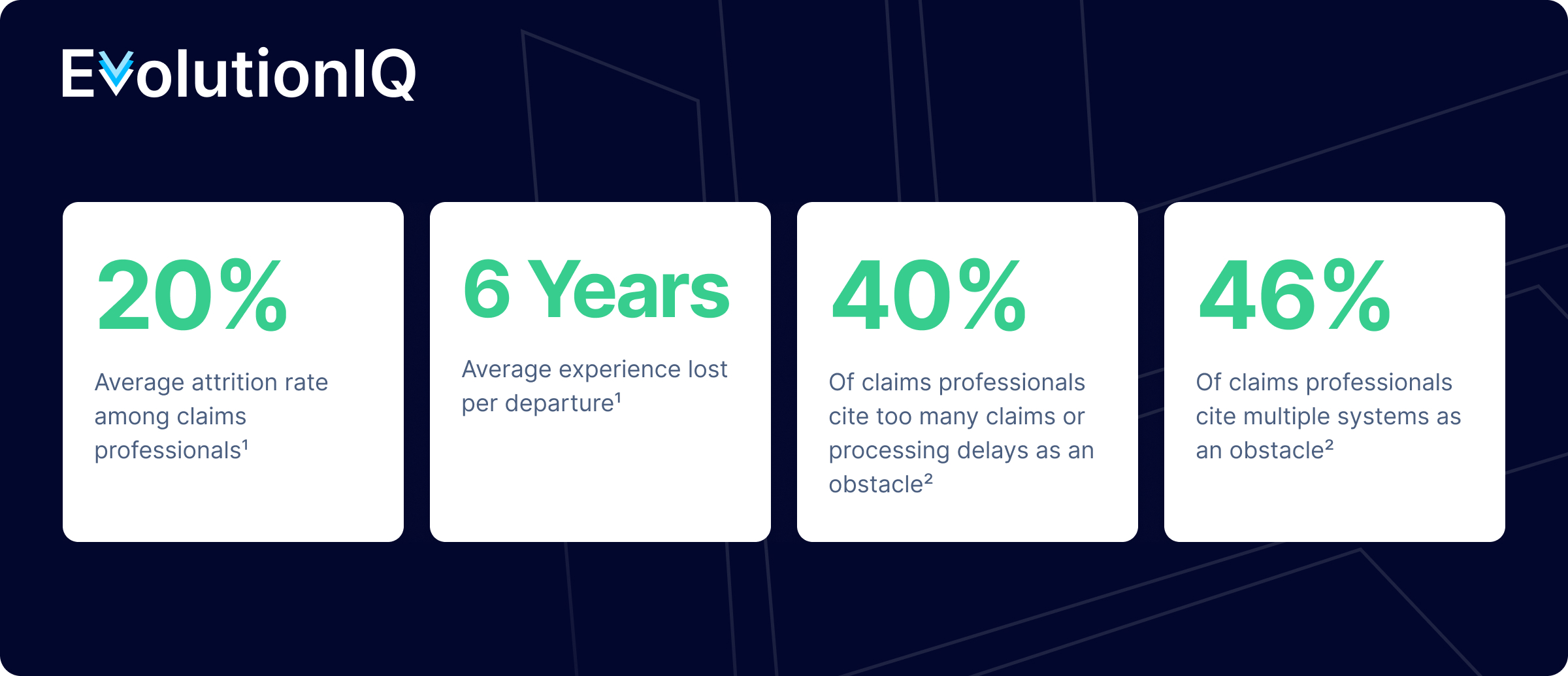
Every lever you pull comes with a cost. Ask examiners to cover more claims, and decision quality drops. Ask them to over-analyze each file deeply to ensure the right outcome, and cycle times swell. Fixing this balance requires changing the operational structure itself.
Claims Judgment at Scale
The best way claims teams can create capacity is by changing how and where to apply human judgment. The biggest constraint has historically been the sheer amount of input required across the claims process, even for routine decisions. Applying that judgment more selectively can lighten the load on routine files and administrative tasks while concentrating expertise on more complex files or higher-impact moments. Scaling judgment in this way requires claims to arrive in a more refined state before an examiner ever opens them.
For routine claims, that means a clear path to eligibility, liability, and closure already reasoned through, and a high-confidence recommendation attached to the file. The examiner can validate that guidance and move on, exhausting minimal time or judgement. For complex claims, it means the examiner opens the file with everything required to support a decision, without the burden of reconciling multiple systems or filtering out irrelevant information with no bearing on the case. Instead, they have the time and information they need to work through the case carefully and arrive at the right outcome.
Routine processing takes up less of an examiner’s time, and they keep the final say on each file. Claimants will experience fewer delays and less friction, with a person still handling the moments that call for one. When that happens, speed and accuracy stop pulling against each other the way they used to.
Agentic Claims Handling Is Harder Than It Looks
Insurance organizations are already working to solve judgment at scale by building and deploying AI solutions. But most of that early tooling points agents at single, narrow tasks, much like the workflow automation tools of a decade ago. Those tools proliferated across organizations until the upkeep became a burden of its own. Aiming agents at routine tasks the same way risks the same result of rising tech debt for marginal efficiency, with indemnity outcomes still traded away for speed.
Making the right decision on each of those files is a significantly more complex challenge. Rather than solving one AI problem, teams need to solve dozens of problems that stretch across data extraction, medical interpretation, jurisdictional rules, duration modeling, return-to-work signals, and regulatory compliance, just to name a few.
It takes real expertise in both agentic frameworks and your organization's claims strategy. The payoff is a system that applies sound human-like judgment to expedite routine decisions and enables better decision-making from examiners on more complex cases.
An Agentic Claims System Built on Your Strategy
So what does that modern agentic system look like in practice? At EvolutionIQ and CCC, we believe carriers need three critical capabilities working together: verified context, decision engines, and strategy orchestration.
Verified context
Organizations must be able to extract and connect claim information from documents and other sources with production-grade accuracy. Every error in contextual extractions, whether from medical or legal documentation, compounds as decisions become more complex.
For example, our teams have found that off-the-shelf LLMs are roughly 70% accurate when extracting context from documents. On its own, 70% might sound sufficient. But those errors compound.
What happens when a single decision rests on four extractions at that rate? The accuracy of that decision can fall to just 24%, getting it right less than a quarter of the time. A reliable context layer is critical to giving both examiners and downstream systems a stronger factual foundation.
Decision engines
Models need to reason over that ingested context using real claims data and domain-specific logic, then provide clear guidance rather than simply surfacing more information or insights. That makes routine decisions easier while preserving examiner judgment for more complex files.
Decision engines are where indemnity outcomes are ultimately won or lost. Reasoning through the specifics of a file to guide an examiner is a far harder problem than surfacing information. It’s also where the largest financial impact of a claim lives. Because of this, we've assembled a leading team of claims guidance experts and AI/ML engineers, and we invest considerable time and resources into solving these challenges every day.
Strategy orchestration
Agent orchestration, of course, is not new. Most organizations already rely on some form of it, though often in a fairly static way to move a file through a fixed set of steps or run a basic workflow. The opportunity is to treat orchestration as a strategic layer by mapping it to how your organization actually runs claims, and giving you the room to simulate and test new ways of working before you roll them out.
Strategy orchestration runs on your own playbook to translate the SOPs, thresholds, and escalation rules your organization already uses into consistent, auditable action. It also picks up new information and rule changes as they happen and applies them to your claims strategy immediately. Because every organization’s strategy is different, every implementation looks different as well.
The Next Five Years of Claims Handling
For years, the tension between claimant experience, indemnity outcomes, and operational efficiency has been treated as a fixed condition of the industry, and something claims leaders were asked to balance. We believe this was always a limitation of the tools available, and those tools are changing.
Over the next several years, the organizations that continue to focus agentic solutions on exclusively speed and efficiency will remain stuck in a loop of optimizing at the margins. Those that pull ahead will be the ones that go deep to design the verified context, decision engines, and strategy orchestration layers that can reliably apply judgment at scale within the claims process.
As a result, claimants who once felt the frustration of every handoff will get a faster, steadier answer. Examiners who were stretched thin across too many files will get to spend their expertise where it truly impacts an outcome. And that tug-of-war that has always defined claims leadership may finally have real slack in the rope.
Notes and Citations
1 Kedar Kamalapurkar, Namrata Sharma, and Sabyasachi Satapathy, "Reimagining claims: Soft skills are the differentiator," Deloitte Insights, September 18, 2025.
2 Healthesystems and Risk & Insurance, "2025-26 Workers' Compensation Industry Insights Survey," February 2026.
Related posts


.avif)

AI powered Claims Guidance.